

Edelman Earned Brand Study

Blog post by Russell Goldsmith, Founder, Audere Communications


For part 2 of Show 31 (starting at 8:31) of the csuitepodcast, the second of the three shows recorded at the Global ICCO PR Summit, I spoke with Michelle Hutton, Chief Operating Officer at Edelman Europe about the findings of the latest Edelman Earned Brand Study.

The theme of this year’s study was disruption, particularly looking at how brands themselves, across 18 different categories, can be disrupters, and this was achieved by researching over 13,000 consumers across 13 countries.

As Michelle explained, marketers have spent a lot of time and money getting consumers from being aware, through consideration and preference, to being loyal.  However, Edelman have found that there is something special beyond loyalty and that if you can get consumers to be committed and really invested in a brand, they will do some pretty amazing things.  Therefore, as part of their study, Edelman have developed a methodology to be able to measure how marketers can be disruptive in their relationship with their consumers.

Michelle said that many people think that in low involvement categories, the concept of being committed is not relevant, but actually, in every single category that Edelman explored, they found that there are already many people committed to brands in those sectors.  However, where many brands are falling short is around the concept of shared value.  For example, those people who want to be committed to the brand want to feel like they are part of the conversation around it – they’ll advocate for the brand, defend them in times of crisis and are there waiting.  However, whilst brands listen well, many don’t often respond well, and therefore, it’s those brands that use those committed consumers to their advantage who are doing it well.

The highest relationship index scored turned out to be in China and the lowest was in the Netherlands.  As for age splits, millennial males were found to be the most engaged segment with brands, which Michelle found surprising.

Michelle then went on to talk about how this all leads to how you can engage consumers to take real action around a brand and she cited Unilever as a best in class example of a company encouraging all of their brand marketers to think long term and creatively about how purpose can not only drive business results through their brands but also make the world a better place.  She also said that disrupter brands understand the shared economy and the power of peer-to-peer and so marketers in more traditional companies need to look at those start-ups, their business models and how they engage, respond and communicate with their consumers.

#ad – Many thanks to global media intelligence provider CARMA for supporting the series of shows I produced from ICCO.  Please do visit their website to find out more about how they can help you deliver actionable insights through media monitoring and PR measurement.

All previous shows of the csuitepodcast series are available on Soundcloud or itunes and please, if you subscribe, can you give the show a positive rating and review on itunes in particular.

The show also now has a Facebook page and Twitter feed so please do follow and get involved in the conversation.
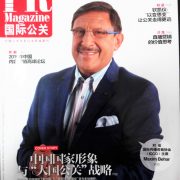

Maxim Behar, ICCO President for Chinese PR Magazine: PR today requires immediate and professional reaction

1\You started your career as a journalist from 1981 to 1995 in Bulgaria ,Czech and Poland. How do you think this experience influenced you?

Especially in that time, back more than 20 years ago, this experience was priceless. And the reason is very simple. Traditional media were the only media and also the only “bridge” between our clients and their target audiences. My deep knowledge of media helped me a lot, indeed I started from a intern and grew up to a Managing Editor of the largest private daily newspapers in Bulgaria. This was meaning by default that I knew exactly what is happening in the “head” of each journalist, how to attract the media, how to write news in a way that professional journalists will immediately get them and put in their newspapers or will speak about them in the TV or radio channels. Without this deep knowledge, at least I think now, it would not be possible to make this “frog leap” in business and soon to become the most professional leader in the Bulgarian PR market.

2\In your opinion, with the great changes of technology and media environment, what changes have happened in the PR industry?

Public Relations business is today one of the most dynamic businesses in the world. The reason of the change is very, very simple. For the first time in the history, since this business exists almost 120 years, not only our clients, but also we as PR experts, own media. In the past it has been true true – we were creating our concepts to attract media and to get their interest to our clients and their products or services. But today we already have the media, our clients have them – these are the social media. And from a “bridge”, as I said, between clients and media, now must become managers of social medial we own. From a purely practical perspective this is already a completely different business, which requires different tools, approaches and even professional education and abilities. We should know how to run media, how to write into them responsibly, intelligently and attractively, how to promote them among the readers and – what is most important – how to respond to the online commentary. Because on the top nowadays we do not have a lot of time to react in social media and the faster we are, the more successful the project will be.

3\Could you talk about the key point of doing good PR services?

The three S, formulated by me many years ago are still valid even much stronger now – – Speed, Simplicity, Self confidence. First of all the speed is really crucial and extremely important. Secondly – the world is so sophisticated today, our tasks are so complicated, that we must have very clear priorities and a simple agenda how to achieve them – simplicity. And the third one, which even might be the first one – I do not know a single successful person who achieved anything without self confidence and desire to do the job perfectly and responsibly.

4\How the PR companies keep and promote key competitive strength in the background of homogenization in PR industry?
There is an obvious merge worldwide among the three main key elements of modern public communications – public relations, advertising and digital. In this merge, which even can happen in full much faster than we can expect. Each of those three businesses now claim they will be the leader of the future merged business. I simply believe that it’ll be public relations, not advertising or digital and have quite strong arguments for that. The main point of those arguments is that we, the public relations experts, are the masters of the real content, of the words, of the sentences and namely content these days is crucially important. And more – clients these days come to our office with two main important problems – reputation problems and crisis management. So, I do not think that advertising or digital can handle this, of course that public relations is the business, which can provide these services to the clients with the important support of the creative design (from the advertising) and proper social media promotion (from the digital).

5\In your opinion, which aspects are important in training PR elites?

Teaching them to manage the social media in the right way and to serve the clients 24 hours, 7 days a week. The rest they will learn by themselves.

6\You were announced “Business leader of the year” in Bulgaria in 2016 , and the Global Award “CEO of the Year in the World” in 2015. What’s feeling about these two award?

Often I say  – when you climb a peak you may see anything else then… the next peak. All those awards, which I have had throughout the years brought me new and higher responsibilities, but also the challenge and desire to achieve more new and interesting things. And to stay on the professional top.

7\What’s your opinion about public relations and media relations in future?

They will be more and more dependable on visions and short movies. And what is important – all public relations projects will be soon implemented only live in real time with the means of video transmission. Which will mean another change of our business – we must be ready to react at any second, personally and professionally. By the way – I really think that the name of our business – “Public Relations” is old fashioned and does not respond to the modern times. When the business was launched more than a century ago some 90 per cent of the relations were non-public, but the rest of 10 per cent were public and then the businessmen and politicians started to hire journalists to advise them how to behave with the media… Today all our life is public and to say “public relations” is very similar to say “transparent window”. Soon the name of the business will be different and the closest I can propose or guess now is “Live Relations”. Everything will be based on live social media and handling this communications will be the most difficult task.

8\What’s your hobby in your spare time? Please make a self introduction.

Golf, playing drums, traveling, fitness, reading, reading, reading… In the modern world if there is a day without at least one new interesting article or book, then it is a wasted day. And if I hate something, then I only hate to waste my time.


“Turning Companies into Storytellers” – csuitepodcast Show 30 Part 3

 Blog post by Russell Goldsmith, Founder, Audere Communications


In final part of Show 30 of the csuitepodcast (starting at 44:18), recorded at the Global ICCO PR Summit, I was joined by Petra Sammer, Partner and Chief Creative Officer at Ketchum Pleon Germany to discuss more about the topic of her presentation at the event, which was titled ‘Turning companies into storytellers’.

Petra advised listeners to be clear when it comes to defining storytelling as there are at least four ways to do so:

  • A rhetoric technique, for example, sprinkling some anecdotes into your speech
  • Journalism
  • Corporate/Brand identity, i.e. the history of where the brand or company comes from
  • How Authors and Scriptwriters use it

Petra said that we see the rhetoric technique being used in the PR industry within media training when teaching clients to be more personal and emotional.  She believes that PR is naturally very good at journalism, where it comes to framing a story and that many in the industry are good at corporate and brand identity too.  However, where she feels there is more learning required, is in the original meaning of storytelling, i.e., how authors and scriptwriters tell a story, and she suggests that there is perhaps a need for more skills need in this area to enable us to show emotion or empathy, particularly when it comes to real narrative.  She puts this issue down to the fact that many people in the PR industry, along with end-clients too, are, in her opinion, facts and information driven and therefore, to be able to show emotion, empathy or make people laugh or even cry, is a skill that is rarely seen.

I mentioned to Petra that when I was part of the CIPR’s Social Media Panel, we wrote a Skills Guide on Social Storytelling, within which co-chair at the time, Dan Tyte of Working Word, quoted Christopher Booker’s Seven Basic Plots to a story:

  1. Overcoming the monster
  2. The Quest
  3. Journey and Return
  4. Rebirth
  5. Rags to Riches
  6. Comedy
  7. Tragedy

Whilst Petra thinks that what Booker has done is brilliant, in her experience, when talking with clients, it can be a bit confusing.  So where these categories could be helpful is when interpreting a story backwards and she used IBM turning themselves into a consulting business as an example of Rebirth. She said a good place to start is to watch Simon Sinek’s Ted Talk ‘How great leaders inspire action’ and his reference to the Golden Circle, starting with the ‘Why?’

However, Petra’s own talk at the conference was about the model built on the four fundamental desires that we all have, which she listed along with brands that could be identified with them:

  1. Wanting to be part of a community and be loved, referring to a campaign by Guinness, where Rugby player Gareth Thomas told his story of coming out as Gay to his team mates.

  1. Security and stability – the need to feel safe – a good example being Fedex always promising that they will deliver
  2. Self-fulfilment – Nike, where they say that everyone can be an athlete
  3. Freedom and independence – Harley Davidson selling the experience … the prouct comes free!

#ad – Many thanks to global media intelligence provider CARMA for supporting the series of shows I produced from ICCO.  Please do visit their website to find out more about how they can help you deliver actionable insights through media monitoring and PR measurement.

All previous shows of the csuitepodcast series are available on Soundcloud or itunes and please, if you subscribe, can you give the show a positive rating and review on itunes in particular.  You can also now follow the show on Twitter and Facebook – please get involved!

"Turning Companies into Storytellers" – csuitepodcast Show 30 Part 3

 Blog post by Russell Goldsmith, Founder, Audere Communications


In final part of Show 30 of the csuitepodcast (starting at 44:18), recorded at the Global ICCO PR Summit, I was joined by Petra Sammer, Partner and Chief Creative Officer at Ketchum Pleon Germany to discuss more about the topic of her presentation at the event, which was titled ‘Turning companies into storytellers’.

Petra advised listeners to be clear when it comes to defining storytelling as there are at least four ways to do so:

  • A rhetoric technique, for example, sprinkling some anecdotes into your speech
  • Journalism
  • Corporate/Brand identity, i.e. the history of where the brand or company comes from
  • How Authors and Scriptwriters use it

Petra said that we see the rhetoric technique being used in the PR industry within media training when teaching clients to be more personal and emotional.  She believes that PR is naturally very good at journalism, where it comes to framing a story and that many in the industry are good at corporate and brand identity too.  However, where she feels there is more learning required, is in the original meaning of storytelling, i.e., how authors and scriptwriters tell a story, and she suggests that there is perhaps a need for more skills need in this area to enable us to show emotion or empathy, particularly when it comes to real narrative.  She puts this issue down to the fact that many people in the PR industry, along with end-clients too, are, in her opinion, facts and information driven and therefore, to be able to show emotion, empathy or make people laugh or even cry, is a skill that is rarely seen.

I mentioned to Petra that when I was part of the CIPR’s Social Media Panel, we wrote a Skills Guide on Social Storytelling, within which co-chair at the time, Dan Tyte of Working Word, quoted Christopher Booker’s Seven Basic Plots to a story:

  1. Overcoming the monster
  2. The Quest
  3. Journey and Return
  4. Rebirth
  5. Rags to Riches
  6. Comedy
  7. Tragedy

Whilst Petra thinks that what Booker has done is brilliant, in her experience, when talking with clients, it can be a bit confusing.  So where these categories could be helpful is when interpreting a story backwards and she used IBM turning themselves into a consulting business as an example of Rebirth. She said a good place to start is to watch Simon Sinek’s Ted Talk ‘How great leaders inspire action’ and his reference to the Golden Circle, starting with the ‘Why?’

However, Petra’s own talk at the conference was about the model built on the four fundamental desires that we all have, which she listed along with brands that could be identified with them:

  1. Wanting to be part of a community and be loved, referring to a campaign by Guinness, where Rugby player Gareth Thomas told his story of coming out as Gay to his team mates.

  1. Security and stability – the need to feel safe – a good example being Fedex always promising that they will deliver
  2. Self-fulfilment – Nike, where they say that everyone can be an athlete
  3. Freedom and independence – Harley Davidson selling the experience … the prouct comes free!

#ad – Many thanks to global media intelligence provider CARMA for supporting the series of shows I produced from ICCO.  Please do visit their website to find out more about how they can help you deliver actionable insights through media monitoring and PR measurement.

All previous shows of the csuitepodcast series are available on Soundcloud or itunes and please, if you subscribe, can you give the show a positive rating and review on itunes in particular.  You can also now follow the show on Twitter and Facebook – please get involved!

“Brand Culture in the Conversation Age” – csuitepodcast Show 30 Part 2

 Blog post by Russell Goldsmith, Founder, Audere Communications


View image on TwitterIn Part 2 of Show 30 of the csuitepodcast (starting at 20:05), recorded at the Global ICCO PR Summit, I had the absolute pleasure of speaking with Pascal Beucler, Senior Vice President & Chief Strategy Officer, Global, MSLGroup (and someone I could have happily chatted to all afternoon), on the topic of ‘Brand culture in the conversation age’, which was the title of the presentation he had given at the conference earlier that day.
View image on Twitter

Pascal said that his talk was based around how PR has evolved from Public Relations to People Relations, creating relationships through content that is full of emotional connections.

He explained this further by talking about how the z-generation, born between the 1990’s and 2010, or those a little older, born between the 1980’s and 2000, have a relationship to brands that is based on mutual respect and parity – that is not top down or intrusive but based on choice, desire, attraction, seduction – and if it is like this it works, otherwise it doesn’t work.

The example of a campaign that MSLGroup had worked on recently that Pascale said was viral video rather than an advert that creates a dialogue between [the brand and] the target they want to address, was the superb Always #LikeAGirl campaign, one that I personally love and continue to feature in my own Using Video in Social Workshop.

Pascale believes the genius behind the campaign is that P&G and Always are saying they deliver much more than protection every month but they deliver a vision of young girls based on the understanding they have a strong desire to be free of the chains that society and men put them in.  This for him, is an example of New Age relationships between brand and people.  It’s not about telling you my product is better than another one, but instead saying there is an issue and so why don’t we discuss it and find a solution. 

Another area Pascale touched on in his talk was that of gamification, which he sees brands using in two ways.  Firstly, gaming is a huge trend for millennials but also for older people, mainly because the smart phone is always in our pocket and so when we have free time, as well as using it to communicate, we use it for gaming and so it provides a perfect compatibility and convergence between the device and the will to be gaming.

The other reason Pascale said gamification is important is due to the power of data created by millions of people on the way they play that you can use to your advantage.  He used the Deutsche Telekom “Sea Hero Quest” as a great example, which, as quoted on their website, was “designed to create the world’s largest crowd sourced data set benchmarking human spatial navigation, helping bring scientists one step closer to developing new diagnostic tests for dementia.”

Pascale believes this kind of activity gives gamification another dimension, something he calls, Brand Utility, where the brand becomes something useful in your life.

There were so many things we spoke about, too much to write about here, and to be honest, it’s much better listening to Pascale explaining it all, but he finished off with what he saw as the main drivers are for brands in the conversation age, which were:

  • Start conversations based on creativity of the mind
  • There is no conversation unless there is equality, equity and parity between the two sides. It has to be two ways. If it is a dominating conversation, it goes nowhere.
  • Conversation is a continuum

#ad – Many thanks to global media intelligence provider CARMA for supporting the series of shows I produced from ICCO.  Please do visit their website to find out more about how they can help you deliver actionable insights through media monitoring and PR measurement.

All previous shows of the csuitepodcast series are available on Soundcloud or itunes and please, if you subscribe, can you give the show a positive rating and review on itunes in particular.  You can also now follow the show on Twitter and Facebook – please get involved!

"Brand Culture in the Conversation Age" – csuitepodcast Show 30 Part 2

 Blog post by Russell Goldsmith, Founder, Audere Communications


View image on TwitterIn Part 2 of Show 30 of the csuitepodcast (starting at 20:05), recorded at the Global ICCO PR Summit, I had the absolute pleasure of speaking with Pascal Beucler, Senior Vice President & Chief Strategy Officer, Global, MSLGroup (and someone I could have happily chatted to all afternoon), on the topic of ‘Brand culture in the conversation age’, which was the title of the presentation he had given at the conference earlier that day.
View image on Twitter

Pascal said that his talk was based around how PR has evolved from Public Relations to People Relations, creating relationships through content that is full of emotional connections.

He explained this further by talking about how the z-generation, born between the 1990’s and 2010, or those a little older, born between the 1980’s and 2000, have a relationship to brands that is based on mutual respect and parity – that is not top down or intrusive but based on choice, desire, attraction, seduction – and if it is like this it works, otherwise it doesn’t work.

The example of a campaign that MSLGroup had worked on recently that Pascale said was viral video rather than an advert that creates a dialogue between [the brand and] the target they want to address, was the superb Always #LikeAGirl campaign, one that I personally love and continue to feature in my own Using Video in Social Workshop.

Pascale believes the genius behind the campaign is that P&G and Always are saying they deliver much more than protection every month but they deliver a vision of young girls based on the understanding they have a strong desire to be free of the chains that society and men put them in.  This for him, is an example of New Age relationships between brand and people.  It’s not about telling you my product is better than another one, but instead saying there is an issue and so why don’t we discuss it and find a solution. 

Another area Pascale touched on in his talk was that of gamification, which he sees brands using in two ways.  Firstly, gaming is a huge trend for millennials but also for older people, mainly because the smart phone is always in our pocket and so when we have free time, as well as using it to communicate, we use it for gaming and so it provides a perfect compatibility and convergence between the device and the will to be gaming.

The other reason Pascale said gamification is important is due to the power of data created by millions of people on the way they play that you can use to your advantage.  He used the Deutsche Telekom “Sea Hero Quest” as a great example, which, as quoted on their website, was “designed to create the world’s largest crowd sourced data set benchmarking human spatial navigation, helping bring scientists one step closer to developing new diagnostic tests for dementia.”

Pascale believes this kind of activity gives gamification another dimension, something he calls, Brand Utility, where the brand becomes something useful in your life.

There were so many things we spoke about, too much to write about here, and to be honest, it’s much better listening to Pascale explaining it all, but he finished off with what he saw as the main drivers are for brands in the conversation age, which were:

  • Start conversations based on creativity of the mind
  • There is no conversation unless there is equality, equity and parity between the two sides. It has to be two ways. If it is a dominating conversation, it goes nowhere.
  • Conversation is a continuum

#ad – Many thanks to global media intelligence provider CARMA for supporting the series of shows I produced from ICCO.  Please do visit their website to find out more about how they can help you deliver actionable insights through media monitoring and PR measurement.

All previous shows of the csuitepodcast series are available on Soundcloud or itunes and please, if you subscribe, can you give the show a positive rating and review on itunes in particular.  You can also now follow the show on Twitter and Facebook – please get involved!

“Recruiting and Retaining Talent”: csuitepodcast Show 30 Part 1

Blog post by Russell Goldsmith, Founder, Audere Communications

Show 30 of the csuitepodcast was the first of three shows recorded at the Global ICCO PR Summit that took place in Oxford at the start of September.

Part 1 of this episode was on the topic of Talent Creation, Recruitment and Retention within the PR & Communications industry.

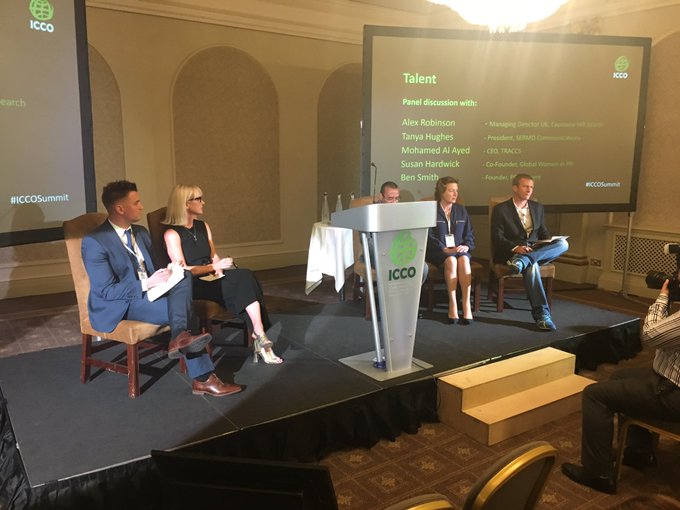
Joining for this first section of the show were Mohamed Al Ayed, CEO and President of TRACCS, Tanya Hughes, President of SERMO, Talk PR’s global network of independent communications agencies, and Susan Hardwick, Co-Founder of Global Women in PR – all three had just been part of a panel session at the conference.

View image on Twitter

My guests all agreed that the critical issues that were being discussed around this topic were global and as Tanya explained, a key theme in her own Group’s international conference was not just on finding the right people, but keeping them happy with job satisfaction and work-life balance too.

When I spoke with Weber Shandwick’s Colin Byrne in Cannes, he said the big issue was the fact that PR agencies’ approach for talent has been to steal each other’s staff and that actually PR needs to recruit the kind of people who are currently going to work at Social Media Platforms or the World’s top Advertising and Digital Agencies, something Karen van Bergen, CEO of Omicom Public Relations Group also touched on in her opening keynote at the ICCO Conference.

View image on Twitter

Sarah agreed.  She explained that her Spanish agency’s Head of Digital came from an advertising agency and in their Hong Kong agency, they’ve just recruited a creative from a Film Production House.  However, she warned that it works both ways as she’s seen her own talent recruited by Ad and Digital agencies too.

Given Susan’s role in Global Women in PR, I asked her if one way of keeping talent in the industry was to tap into the growing freelance network, particularly in encouraging mums back into the industry.

However, Susan said that whilst freelancers plug gaps, do project work, add value when necessary when you don’t need to employ somebody for 52 weeks in the year, or offer specialists to balance out the team, the difficulty, particularly in relation to mums coming back to work, is in dealing with is the very big gap between leaving work to have children and coming back, as our world changes very rapidly.  She therefore feels there needs to be work on both sides, i.e. perhaps offering retraining to allow returning mums to get up to speed.

Sarah added that in her experience, she felt employers are actually fairly flexible, certainly in her agencies, particularly in creating work-life balance and ensuring people are happy at work.  However, she said that recent experience for returning working mums, particularly after having their first baby, can be a bit of a shock and given the PR industry is a service industry, even if people are working part-time, they are expected to be available to service their client and do longer working hours.

H+K Strategies’ Richard Millar previously said on this series that that the make-up of his agency had fundamentally changed over the last two or three years and that he couldn’t remember the last time he interviewed someone with a typical PR background.  Mohamed made an interesting point on this as he talked about the evolution of the word talent, where it has evolved from ‘employees’ through ‘resources’.  He agreed in that those people who PR recruits don’t need to be PR people by education.  However, in his view, talent is defined by the organisation’s recognition of the skill and the personality of an individual that will suit and best serve their purposes.  At TRACC, Mohamed actually has engineers, a doctor and a psychologist in the team.

One aspect we touched on was retention of as much as attracting new talent and one of the ways Sarah looks to achieve that at Talk PR is in the organisation’s ‘Learning & Inspiration Programme’, which consists of 52 Masterclass workshops, each geared around personal development for everyone in the agency, from junior to board level.  They include everything from helping people to present or run meetings, to handling conflict and business and financial management.  They also aim to inspire the team by getting external speakers in and organising cultural trips plus development for the team’s client relationships too, including measurement and evaluation or helping to pitch great stories to the media and influencers.

When summing up, my guests offered the following advice between them when it comes to attracting the best talent to the industry:

  • Create a great environment in which to work, i.e. a place where people will be banging at your door and want to be part of your team
  • Do great work and promote the hell out of it
  • [ensure] Transparency, Ingenuity and Integrity

#ad – Many thanks to global media intelligence provider CARMA for supporting the series of shows I produced from ICCO.  Please do visit their website to find out more about how they can help you deliver actionable insights through media monitoring and PR measurement.

All previous shows of the csuitepodcast series are available on Soundcloud or itunes and please, if you subscribe, can you give the show a positive rating and review on itunes in particular.

"Recruiting and Retaining Talent": csuitepodcast Show 30 Part 1

Blog post by Russell Goldsmith, Founder, Audere Communications

Show 30 of the csuitepodcast was the first of three shows recorded at the Global ICCO PR Summit that took place in Oxford at the start of September.

Part 1 of this episode was on the topic of Talent Creation, Recruitment and Retention within the PR & Communications industry.

Joining for this first section of the show were Mohamed Al Ayed, CEO and President of TRACCS, Tanya Hughes, President of SERMO, Talk PR’s global network of independent communications agencies, and Susan Hardwick, Co-Founder of Global Women in PR – all three had just been part of a panel session at the conference.

View image on Twitter

My guests all agreed that the critical issues that were being discussed around this topic were global and as Tanya explained, a key theme in her own Group’s international conference was not just on finding the right people, but keeping them happy with job satisfaction and work-life balance too.

When I spoke with Weber Shandwick’s Colin Byrne in Cannes, he said the big issue was the fact that PR agencies’ approach for talent has been to steal each other’s staff and that actually PR needs to recruit the kind of people who are currently going to work at Social Media Platforms or the World’s top Advertising and Digital Agencies, something Karen van Bergen, CEO of Omicom Public Relations Group also touched on in her opening keynote at the ICCO Conference.

View image on Twitter

Sarah agreed.  She explained that her Spanish agency’s Head of Digital came from an advertising agency and in their Hong Kong agency, they’ve just recruited a creative from a Film Production House.  However, she warned that it works both ways as she’s seen her own talent recruited by Ad and Digital agencies too.

Given Susan’s role in Global Women in PR, I asked her if one way of keeping talent in the industry was to tap into the growing freelance network, particularly in encouraging mums back into the industry.

However, Susan said that whilst freelancers plug gaps, do project work, add value when necessary when you don’t need to employ somebody for 52 weeks in the year, or offer specialists to balance out the team, the difficulty, particularly in relation to mums coming back to work, is in dealing with is the very big gap between leaving work to have children and coming back, as our world changes very rapidly.  She therefore feels there needs to be work on both sides, i.e. perhaps offering retraining to allow returning mums to get up to speed.

Sarah added that in her experience, she felt employers are actually fairly flexible, certainly in her agencies, particularly in creating work-life balance and ensuring people are happy at work.  However, she said that recent experience for returning working mums, particularly after having their first baby, can be a bit of a shock and given the PR industry is a service industry, even if people are working part-time, they are expected to be available to service their client and do longer working hours.

H+K Strategies’ Richard Millar previously said on this series that that the make-up of his agency had fundamentally changed over the last two or three years and that he couldn’t remember the last time he interviewed someone with a typical PR background.  Mohamed made an interesting point on this as he talked about the evolution of the word talent, where it has evolved from ‘employees’ through ‘resources’.  He agreed in that those people who PR recruits don’t need to be PR people by education.  However, in his view, talent is defined by the organisation’s recognition of the skill and the personality of an individual that will suit and best serve their purposes.  At TRACC, Mohamed actually has engineers, a doctor and a psychologist in the team.

One aspect we touched on was retention of as much as attracting new talent and one of the ways Sarah looks to achieve that at Talk PR is in the organisation’s ‘Learning & Inspiration Programme’, which consists of 52 Masterclass workshops, each geared around personal development for everyone in the agency, from junior to board level.  They include everything from helping people to present or run meetings, to handling conflict and business and financial management.  They also aim to inspire the team by getting external speakers in and organising cultural trips plus development for the team’s client relationships too, including measurement and evaluation or helping to pitch great stories to the media and influencers.

When summing up, my guests offered the following advice between them when it comes to attracting the best talent to the industry:

  • Create a great environment in which to work, i.e. a place where people will be banging at your door and want to be part of your team
  • Do great work and promote the hell out of it
  • [ensure] Transparency, Ingenuity and Integrity

#ad – Many thanks to global media intelligence provider CARMA for supporting the series of shows I produced from ICCO.  Please do visit their website to find out more about how they can help you deliver actionable insights through media monitoring and PR measurement.

All previous shows of the csuitepodcast series are available on Soundcloud or itunes and please, if you subscribe, can you give the show a positive rating and review on itunes in particular.

Executive Summary – World PR Report 2016

Article by Francis Ingham, Chief Executive of ICCO

The ICCO & PRWeek World PR Report is the definitive analysis of where the global PR and comms industry stands today; how it has been performing over the past year; and what it predicts will happen in the next few. Drawing on the breadth and depth of ICCO’s membership – 37 national associations, operating in 48 countries, and representing more than 2,500 agencies – it is a vital tool in understanding our industry.

What are the headlines?

Agency heads are optimistic. On a scale of 1-10, there is a global average of exactly 7. The most optimistic markets are the UK (8.1), and the Middle East (8.0); the least are Latin America (5.9), and Africa (6.0).

And they are expecting an increase in profitability, with a score of 6.2. Leading the pack is North America (7.2), followed by the UK at precisely 7. At the other end, we have Latin America again (5.2), and Western Europe (5.7).

Both of those findings deserve celebration, given the at times tempestuous and uncertain state of the world economy. What is driving this performance? I would highlight three factors, which we have seen for the past few years now, and which are remarkably constant region-by-region.

The first is chief executives taking corporate reputation seriously. Quite simply, the business community around the world is more aware than ever before of the fact that their most important asset is their reputation.

The second is that marketers are taking their spend away from other disciplines, and diverting it into more effective mediums of PR and comms. And the third is that clients are increasingly asking public relations firms to provide non-traditional services.

Those last two points amount to one incontrovertible trend – in an increasingly integrated marketing world, PR’s nimbleness, insight, and creativity is beating the competition.

What have been the main practice areas of growth?

Four stand out head and shoulders above the rest – digital comms; corporate reputation; marcomms; and public affairs. And when agency heads are asked to predict which sectors will drive growth over the coming years, they name exactly those four again.

Obviously, there are variations by region, reflecting different local priorities, and different levels of market maturity. But the message is clear – those areas have driven growth in the past, and are set to do so again in the future. Looked at by sector, we again see four key areas of growth now and in the future – technology; consumer; healthcare; and financial and professional services. And underpinning all of this behaviour is the crucial role PR and comms agencies now play in social media and community management, and in creating content across the whole range of media – areas where wise agencies are making significant investment. So far, so encouraging.

But what of the challenges faced by the industry?

It will come as no surprise that two perennial ones are right up there – meeting profit margins, and handling general economic conditions. The first is a symptom of PR’s inability to charge appropriately for the value it delivers – former ICCO chairman Richard Houghton’s regular lament that ‘Fridays are free’; the second is something over which we have no control.

The area where we certainly have the ability to make a difference is talent. In six of the nine world regions, it tops the bill as the key challenge. In fact, only in Asia does talent not rank in the top three. Although our industry continues to power ahead, its growth is being hindered by our failure to attract and then to retain the very best.

Within that challenge are two specific areas of concern: hiring senior staff, and attracting people from non-traditional background. The latter is of particular concern to ICCO. If agencies keep on recruiting the same type of person, with the same type of background, they are automatically excluding themselves from large parts of the market. The more varied teams are, the abler they are to deliver excellent services to the widest possible range of clients.

I would make two final observations: First, and it is a point made by several contributors from different regions, the industry has reached a happy place of maturity. Social media and content may be the biggest areas of growth, but there is still room for the older skills of PR and comms, such as media relations. And that place exists in established and developing markets.

There is, quite simply, a home for all branches of our profession.

Second, what a brilliant time to be in this industry. Even in difficult economic circumstances, PR and comms agencies are profitable, growing, and optimistic.

How would I sum up the future? Bright. And getting brighter.

Download a free copy of the ICCO & PRWeek World PR Report 2016 here


Trends transforming global PR

Article by Tanya Hughes, President, SERMO Communications

This summer, we locked SERMO’s 15 lifestyle PR agencies from all over the world in a conference room in Milan for three days to talk about transformation.  Transformation of clients’ and brands’ needs, of our services, of digital influence, of retail and technology, of our staff makeup. There was plenty of inspiration and plenty of handwringing. In the end we agreed that ‘only the paranoid survive’ and that that’s a good thing. Here are outtakes from the conference – the trends we think are transforming global PR:

  1. Every company is a digital company

Generalist PR skills such as writing, media relations, event management and strategic planning are still core competencies. But now that digital content is the new ‘me time’, every agency is piling in to fill the space. Specialist skills in multimedia content development, SEO, social and digital and analytics are now critical ingredients in the arsenal of progressive PR agencies. To find these digital experts, SERMO agencies are recruiting from media, advertising and production agencies. Nota Bene in Spain have recruited Art Directors, Online Marketing Managers and IT/Programming Managers and Mojo PR in Dubai have a new Head of Creative Content who’s highly connected to filmmakers and other producers, training agency staff in video production and editing.

  1. Keep millennials happy

How to keep our people happy, especially ‘millennials’, was a hot topic this year. Millennials (those born between the 1980s and 2000s) need targeted attention. They have grown up in a society thriving on rapid technological advancement. They expect to be able to access the latest technology at work. Upgrade or die! For them, change is the constant, and they demand this from an employer – they want their careers to progress quickly. According to a report produced by PwC Australia, 71% of millennials are dis-engaged at their jobs as a result of this sense of entitlement. SERMO agencies know that human capital is their biggest asset so they’re investing in training, tailored benefits and new perks to help recruit and retain the very best talent. Talk PR in the UK have introduced a mentoring programme, RSVP in Singapore hold weekly yoga classes in the office to improve staff’s health and wellbeing and Tomorrowland Group in Australia have introduced a quarterly reset day (extra holiday day every quarter) to help their people maintain a work/life balance. All report improved retention and productivity.

  1. The seismic shift in retail

Retail, and fashion retail in particular, is going through enormous structural change. From the push for change in the now outdated two season fashion calendar, to the shift in consumer buying habits facilitated by digital and mobile technology. We heard from expert e-commerce speakers. POPSUGAR talked about the challenges of co-creating content for brands that will grab the eight second attention span of Gen Z, the domination of mobile and the holy grail of marketplace sites – seamless check out. While Yoox said their customers know what they want and come to them to shop, not for content! At the sharp end of technology, Metail are creating virtual fitting rooms that will improve and personalise service and cut returns. In the real world, bricks and mortar retail is moving toward creating experiences that can’t be replicated online.

All of which has implications for PR – the lifecycle of fashion/lifestyle stories is shorter and requires an integrated approach across content and channels, from influencer marketing to creative execution. It’s all about driving sales across all consumer touchpoints. Working with digital influencers, in particular, now drives huge sales for brands and retailers, often resulting in completely sold-out pieces.

  1. Redefining influence

Influence is not what it used to be. It’s more complex and dynamic and, above all, digital. But the digitisation of influence, doesn’t diminish PR’s core competence – harnessing influence through relationships. What it does mean is that working with digital influencers and KOLs and creating compelling digital content requires constant innovation – Negri Firman in Italy has set up a creative content arm called NFLAB, Flare in Hong Kong set-up a social and digital PR Hub in summer 2015 which now contributes over 33% of their total revenue, Tomorrowland Group in Australia and RSVP in Singapore have launched Talentland and RSVP@Talent (respectively) to manage the profiles of experts, digital influencers and creators. SERMO agencies like Adventi in China are also offering integration of paid, owned, shared and earned media and broadening their portfolio from working with digital influencers and paid amplification to programmatic advertising.

  1. Global media vacuum

Condé Nast Italia impressed us all with their innovative work with brands and co-created, extraordinary content. But what they can’t do, and what no major publishing house can do, is press a ‘button’ for global reach. There’s really no such thing as truly global media. We know this from our work with global clients such as Pernod Ricard and Procter & Gamble. It occurred to us that we could bring each of our market’s local influencers together, connected by the network partners, to create tangible global online reach for our clients’ brands. And at the same time, help influencers extend their global reach. So our next step is to make the SERMO Digital Influencer Index interactive, live and a service for clients and influencers – watch this space.